The Case for the 20-Hour Game
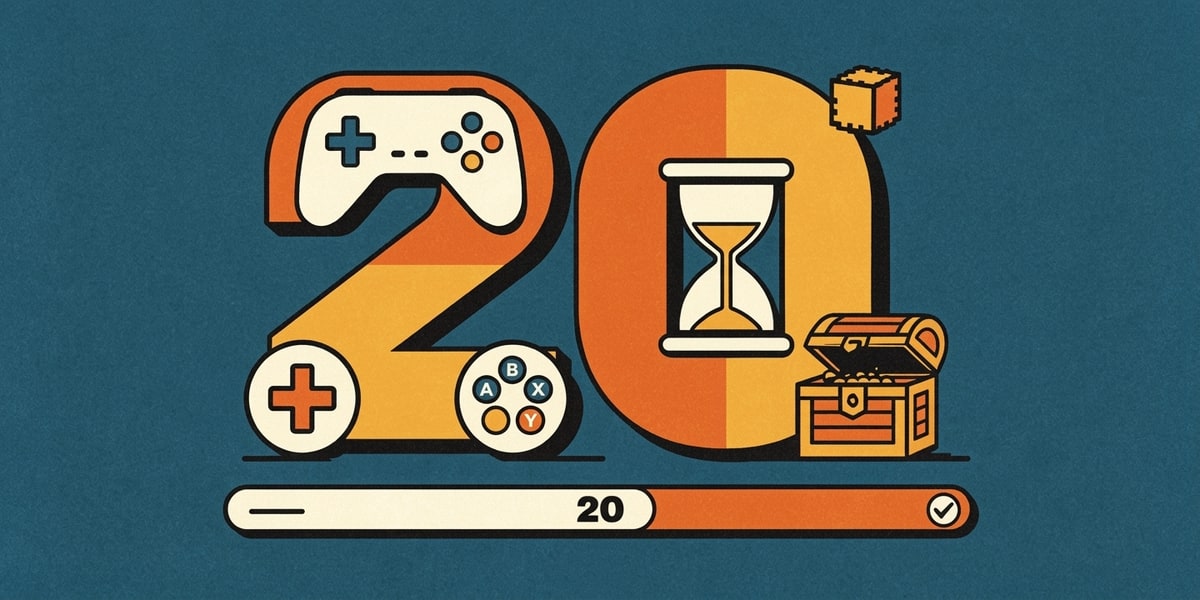
The trend line in mainstream gaming has been going one direction for two decades: longer. Bigger open worlds. More side content. Higher completion numbers on the box. Publishers know that "80 hours of content" reads as value on a store page, so they build for it.
But if you look at the games that players actually finish, remember, and recommend to friends, a lot of them land closer to twenty hours than eighty. Here's the case for the mid-length game.
**1. Twenty hours matches how real people actually play.**
The average adult with a job and a life gets maybe five to eight hours of gaming time a week. A twenty-hour game finishes in about a month at that pace. That's a season of your life, not a decision to reorganize your calendar. Long games ask you to commit before you know if you'll like them; twenty-hour games ask for a fair trial.
**2. The story stays coherent.**
Almost every game that swells past forty hours has structural problems in its writing. The mid-game slumps. The stakes reset. Characters develop in loops. That's not a failure of individual writers; it's what happens when a plot has to sustain a runtime it wasn't naturally built for. Twenty hours is long enough for a real story arc and short enough to hold together.
**3. Every mechanic gets to matter.**
A short game teaches you a mechanic and then makes you use it well. A long game teaches you a mechanic and then makes you grind through it a hundred more times. When a game has room to breathe but not room to sprawl, every system in it gets meaningful screen time. You don't outgrow the tools; you actually get good at them.
**4. Endings hit harder.**
A great ending in a short game feels like a real conclusion. A great ending in a long game often has to compete with your own fatigue. When you've been in a world for twenty hours, the last two hours can genuinely land — you're not exhausted yet, and the writers know you're paying attention. Whatever the ending is, you'll remember it.
**5. Finishing means something.**
Steam studies have shown that only a small fraction of players finish long RPGs. Most players simply drift off in the mid-game. But shorter games get finished — completion rates for six-to-twenty-hour titles are dramatically higher. There's a real satisfaction in reaching the end of a story on purpose, and shorter games make that possible in a way longer ones structurally can't.
**6. It leaves room in your library.**
If every game you buy costs you thirty hours minimum, you play a handful a year. If most games you buy cost you fifteen to twenty-five, you play three times as many. Shorter games mean you get to be a wider reader — you experience more genres, more perspectives, more mechanics. The variety compounds.
**7. Longer isn't the same as deeper.**
The best-remembered games in recent memory are often not the longest ones. A tight, twelve-to-twenty-hour game with real ambition tends to leave more mark than an eighty-hour game with padding. Depth is a function of density, not runtime. Some of the most respected games ever made are genuinely brief.
---
Nothing in this argument is against long games. There's a place for the massive one-off you sink a summer into. But the industry has drifted so hard toward "more" that the mid-length game — the twenty-hour game with a real arc, well-earned ending, and mechanics that stay fresh — has been forgotten. It's still the format that respects a working adult's time. It's still the format most players actually finish. And it's still, more often than not, where the best writing in games lives.