
How Ancient People Told Time Before Clocks
Every time you glance at your phone, you're using a technology that's less than a thousand years old in its earliest mechanical form, and less than a century old in the wristwatch form most people know. For the vast majority of human history, people managed their days without any of it.
Here's how ancient societies actually kept time — and how well those methods worked.
The sundial: the oldest time technology
The most durable answer to "what time is it" for thousands of years was: look at the sun.
Ancient Egyptians used shadow clocks and obelisks by around 1500 BCE — literally measuring the length and angle of a shadow cast by a vertical stick to tell time of day. The Greeks and Romans refined this into portable sundials, some sophisticated enough to account for the changing seasons. A well-designed sundial could tell you the hour within maybe 15 or 20 minutes, which was plenty for a world that didn't need to catch a train.
The catch: sundials only work when the sun is out. They're useless on cloudy days, useless at night, useless in high latitudes during winter. Which is why every ancient civilization also needed a backup.
Water clocks: the first time technology that worked in the dark
The Egyptians also invented the water clock, or *clepsydra*, around the same period. The basic principle is simple: water drips at a roughly constant rate from a vessel with a hole in the bottom. You mark the vessel with graduated lines, and as the water level drops past each line, you know how much time has passed.
Water clocks were used across the ancient world — Greek courts used them to time speeches, Chinese engineers built elaborate multi-tiered water clocks with automated figures, and Islamic scholars developed astonishingly sophisticated versions in the medieval period.
Water clocks had one big advantage over sundials: they worked at night, indoors, and in bad weather. They had one big disadvantage: water flow varies with temperature, pressure, and evaporation. A water clock in winter and one in summer would run at different speeds.
Hourglasses: portable, if imprecise
The hourglass — sand flowing through a narrow neck between two bulbs — is a medieval invention that solved some of the water clock's problems. Sand doesn't evaporate, doesn't freeze, and isn't affected by temperature nearly as much.
Hourglasses became especially important on ships, where consistent movement made water clocks impractical. Sailors used a half-hour glass to measure the ship's watches — the origin of the word "watch" as a time period, not just a device.
The tradeoff is that hourglasses only measure a fixed span of time. You can't ask an hourglass what time it is. You can only ask it how much time has passed since you flipped it.
Candle clocks: time by burning
The medieval world also used candle clocks — candles marked with rings that indicated hourly intervals as the wax burned down. King Alfred the Great of England reportedly used candles marked in specific increments to organize his day.
Candle clocks are less accurate than most alternatives — wax burns unevenly, drafts change the rate, and the type of wax matters. But they had one specific advantage: they could tell time while you slept. A candle burning down through the night would let you know, roughly, what hour you'd woken up in.
Bells, prayer calls, and public timekeeping
For the average person in the pre-industrial world, timekeeping was often not their problem — it was the community's problem. Church bells rang the hours across medieval Europe. Muslim communities were called to prayer five times a day by the muezzin. Chinese cities used drum towers to mark hours across the day.
In practical terms, this meant most people didn't need to know the exact time. They needed to know whether it was morning, midday, evening, or night, and they needed to know when the bells rang for something specific — mass, market opening, curfew. The community handled precision on their behalf.
Stars: nighttime navigation
Night timekeeping, especially before mechanical clocks, often relied on the stars. Certain stars rise and set at predictable times, and the position of specific constellations relative to the horizon could tell an experienced observer roughly what hour of the night it was. Sailors and shepherds — anyone who was routinely awake at night — became fluent in reading the sky.
Why the mechanical clock changed things
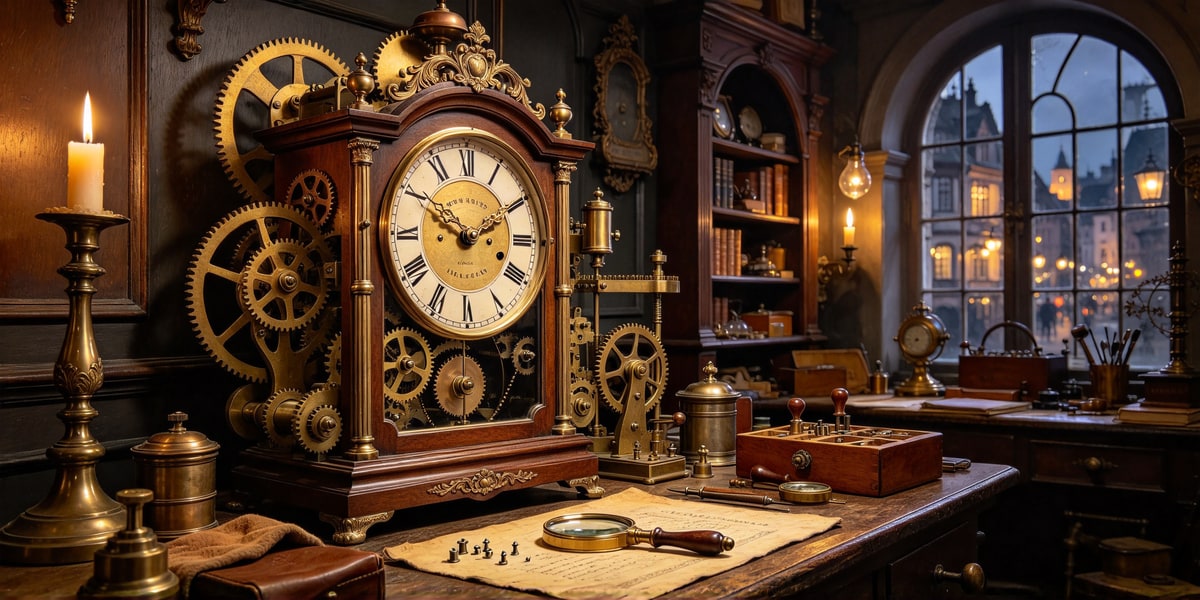
Mechanical clocks with weight-driven gears started appearing in European monasteries in the 13th and 14th centuries. Their appeal wasn't accuracy — early mechanical clocks were less accurate than a well-maintained sundial. Their appeal was that they worked in the dark, indoors, in any weather, and consistently across seasons.
Once these clocks could be miniaturized, first into tabletop clocks and eventually into portable pocket watches, human relationship with time changed permanently. People stopped depending on the sun, the community bells, or the stars. Time became a portable individual resource.
Whether that was progress is genuinely debatable — but the alternative, for most of human history, was elegant, community-scaled, and closer to the sky than we tend to remember.