Why the Number Seven Shows Up Everywhere in Culture
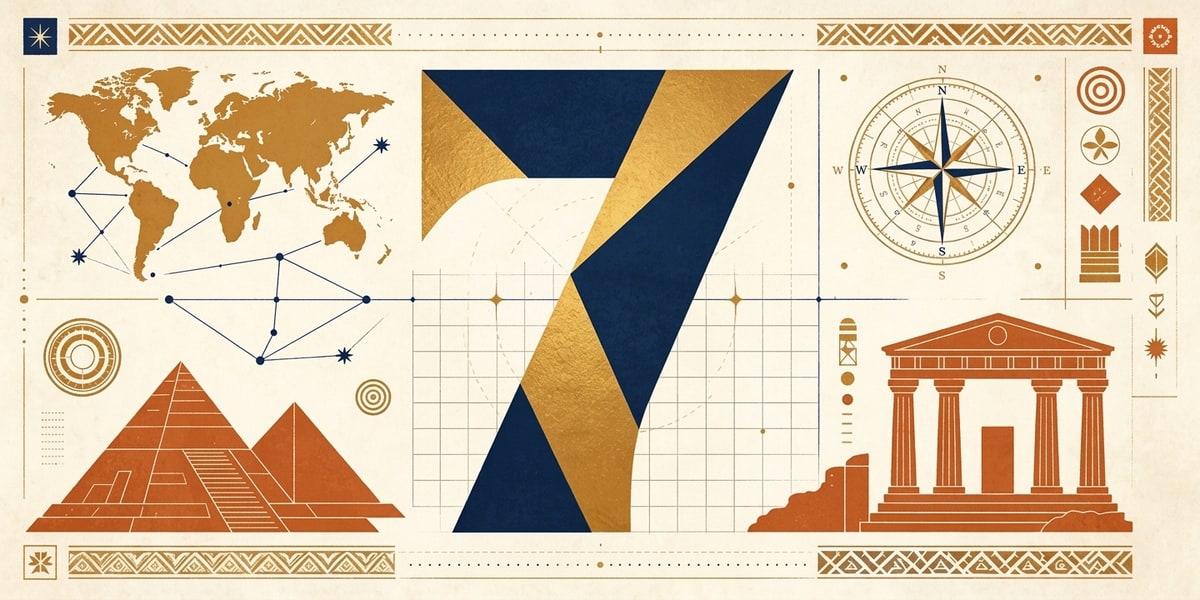
Once you start looking, the number seven turns up in a strangely large number of places.
Seven days in a week. Seven wonders of the ancient world. Seven seas. Seven notes in a Western musical scale. Seven deadly sins. Seven virtues. Seven colors in the standard rainbow. Seven continents on most modern maps. Seven chakras in the traditional Hindu-yoga system. The seven dwarfs. The Seven Samurai. Seven years of good luck (or bad). The list goes on well past the point of coincidence.
There are actually several reasons the number keeps showing up, and they layer on each other.
Ancient astronomy did it first
Long before modern science, cultures around the world could observe seven "wandering" objects in the sky with the naked eye: the Sun, the Moon, and the five bright planets known to the ancients (Mercury, Venus, Mars, Jupiter, Saturn). Everything else was fixed stars. That number — seven — became load-bearing in astronomy and, from astronomy, in calendars.
The seven-day week itself descends from this. Ancient Mesopotamians and later cultures organized time around those seven celestial bodies, and the naming pattern persisted into modern languages. The days are literally named for them.
Humans are wired for it
Psychology research has repeatedly found that seven is roughly the upper limit of what human working memory can hold at once. The classic paper on this — often summarized as "the magical number seven, plus or minus two" — described how people struggle to hold more than about seven distinct items in short-term memory. Phone numbers were originally seven digits for exactly this reason.
Because seven is at the edge of what feels manageable, it shows up in categorizations across culture: seven virtues, seven sins, seven notes, seven categories of X. It's a number big enough to feel comprehensive and small enough to remember. Any classification that grows past it tends to feel unwieldy.
Religious and mythological weight
Seven has heavy religious history. In the Hebrew Bible, God rests on the seventh day. There are seven ranks of angels in some traditions. Islam describes seven heavens. Christian scripture lists seven deadly sins and seven virtues. Buddhism and Hinduism both use the number in cosmological structures. Once a number becomes sacred in one tradition, it tends to keep showing up as culture borrows from culture.
Storytellers love it
Once seven was culturally established, writers and myth-makers kept reaching for it — because a group of seven feels intuitively right. Big enough to be a company, small enough that each member can have a personality. Seven dwarfs. Seven samurai. Seven wonders. Seven seas. Even the standard rainbow has seven colors (though this was actually an aesthetic choice: Isaac Newton originally wanted the rainbow to have seven colors to match the seven notes of the musical scale, which is why "indigo" gets a slot most people can't quite point to).
It compounds
Once seven is established in enough places, new categorizations tend to inherit the pattern. New myths use seven. New belief systems use seven. New pop culture — seven Harry Potter books, seven seasons of a beloved show — reaches for the same number because it feels correct. Cultural momentum is a real force.
---
None of which means seven is genuinely magical. It's just that a specific set of coincidences — visible planets, working memory limits, religious history — locked it into the human imagination early. From there, it's been repeating itself for thousands of years.
The next time you notice a group of seven somewhere, you'll know why it's not a coincidence. It's a very old pattern, and it's still going.