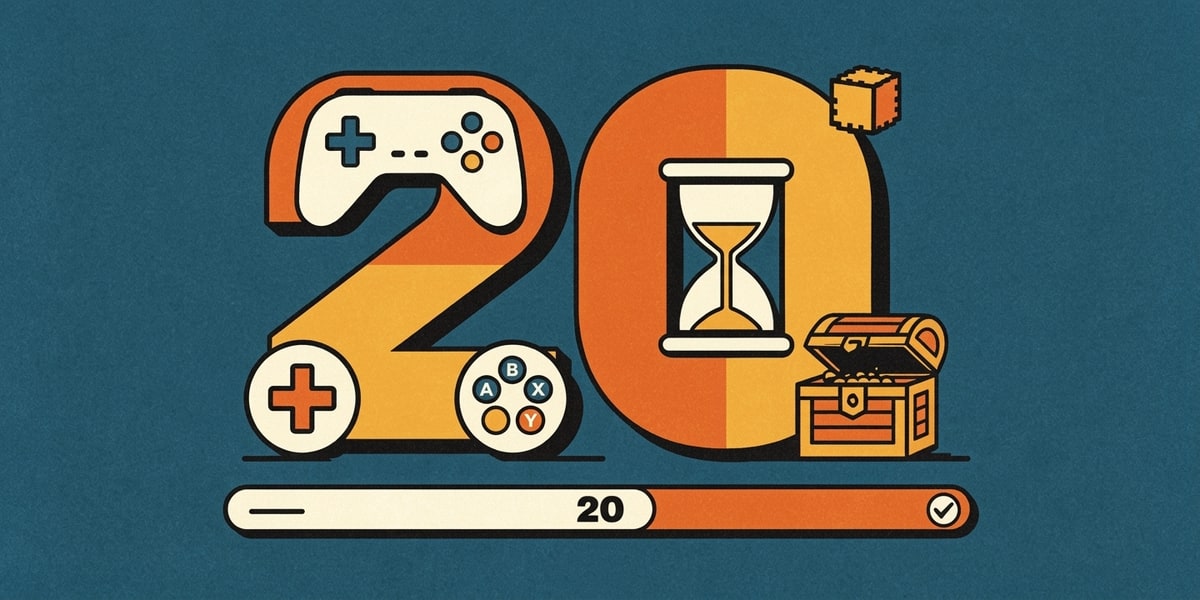
Why Some Video Games Feel Timeless: The Anatomy of a Classic
Every gamer has had the experience. You go back to a game you loved ten years ago, expecting to be disappointed — the graphics were probably rough, the controls probably clunky, the writing probably naive. And sometimes you're right. But sometimes you play for twenty minutes and it just works. The game is exactly as good as you remembered, and in some ways better, because now you notice the craft.
What separates the games that age gracefully from the ones that only worked in their moment? The answer, it turns out, is rarely about graphics. Fidelity dates fast; design doesn't. The games that feel timeless share a set of underlying qualities — most of them decisions made before a single texture got rendered.
Design that respects the player's time
Games that hold up over decades tend to have a specific kind of respect for the player. They don't waste time. Every menu is short, every tutorial is either brilliant or absent, and the game trusts you to figure things out once it's shown you what it wants. When a game teaches you a mechanic in ninety seconds and then lets you own that mechanic for the next twenty hours, you feel it. When a game holds your hand for the first three hours and doesn't trust you until you've proven yourself, that feeling ages badly.
The best classics feel efficient. They know that your attention is expensive, and they spend it carefully.
Mechanics that teach without lecturing
Related to the above: timeless games tend to teach through play, not through pop-up boxes. You learn how to jump because there's a small gap. You learn how to fight because you meet a weak enemy in a controlled space. By the time the real challenges arrive, you already know how to handle them — nobody had to tell you.
This kind of environmental teaching is often invisible when it works. You don't notice you were being taught until you look back and realize the first ten minutes of the game were doing quiet, precise work to prepare you. Games that trust design to teach — instead of a talking character or a mandatory tutorial dungeon — feel timeless because the learning is embedded in the play itself.
An aesthetic that ages, not just a resolution
High-fidelity graphics date fast. Stylized visual identity almost never does. A game that leaned into a hand-drawn look, a cel-shaded palette, a pixelated retro aesthetic, or a specific art-direction choice tends to still feel alive years later. Meanwhile, games that tried to look "as realistic as possible" for their time now often look like flat, plastic versions of themselves — because "realism" is a moving target that the current generation always wins.
Great classic games chose an art direction that wasn't chasing realism. They chose a visual identity — and identity doesn't age the way resolution does.
Difficulty that scales with the player, not the schedule
A lot of modern game design pushes toward long runtimes because a bigger game is easier to market. But most of the games that hold up don't waste your time. They're the right length for the story they're telling, and their difficulty scales with how much attention you're actually paying — not with how many hours the marketing team wanted the box to advertise.
Timeless games tend to feel like they end at the right moment. You come out slightly wanting more, not slightly relieved it's over. That's a hard thing to design for. But when a game gets it right, it becomes something you replay every few years just to feel it again.
Sound that carries the game
The most underrated thing about classic games is how much of their staying power lives in the audio. A great score, a memorable set of sound effects, a musical motif that plays over the credits and then in your head for a week — these age much better than any visual asset. When you think of the games that lasted, you can often hear them before you can see them.
Sound is emotional shorthand. It's why so many classics have soundtracks that continue to sell decades later, and why so many players will insist they can hum the opening theme of a game they haven't played in fifteen years.
A world that trusts the player
Underneath all the specific craft is one general quality: the games that last treat the player as a partner, not a captive. They let you explore. They reward curiosity. They don't punish you for taking the long way around. When a game is generous with its world — leaves you room to poke around, encounter secret things, take detours — the whole thing feels alive rather than scripted.
That kind of trust doesn't age. Games that treated their players as intelligent adults in 1998 still feel like they respect you today. Games that assumed you needed constant guidance in 2018 already feel a little patronizing now.
Why the classics we still play were designed for us
The strange truth is that the best classic games didn't get lucky. They got made carefully. Someone decided, at each of the decision points above, to do the harder, less-marketable thing. Someone decided that the tutorial should be shorter, the aesthetic should be stylized, the runtime should be honest, the trust should be real.
The result is a small library of games that keep working. Not because we're nostalgic for them, but because they were built to keep working. That's the actual definition of a classic — a game that doesn't need our patience or our nostalgia. It just holds up.